The Knowledge Gap and Food Safety
Have a safe Holiday by learning these easy food safety tips
Doggie Bags -Yeah, you’ve made it through the week. Whether you are out on a much needed date with your husband or out with the kids this Friday night, think twice about leftovers. If headed home right away, this may be ok. If you are headed for a leisurely stroll or out to the movies, pass on the doggie bag. Remember the two hours rule and the Danger Zone. Bacteria start to multiply rapidly after two hours especially between the temperatures of 40°-140°F (referred to as the Danger Zone).
Food safety seems to only catch our attention when there is a news flash as was the case with last year’s tainted spinach. According to the Centers for Disease Control and Prevention, approximately 76 million cases of food-borne disease occur annually in the United States resulting in 325,000 hospitalizations and 5,000 deaths each year.
Young children and the elderly are at particular risk especially because dehydration in these two age groups can have serious health implications. Other groups at risk include pregnant women and people with weakened immune systems.
Often we think we just have a 24 hour stomach bug. It is hard to differentiate between food poisoning and the stomach flu because symptoms such as stomach cramps, nausea, diarrhea, headache, and fever can accompany either condition.
Unfortunately, there is still a knowledge gap about food-borne illness. Many consumers believe that food poisoning only occurs shortly after eating. The real truth is that symptoms can occur as early as two hours after eating to a few days after exposure. Consumers also may believe that they got sick from something they ate at a restaurant vs. something they made in their own home.
The good thing about food-borne illness is that it is preventable. One important thing to be aware of is the Danger Zone: temperatures between 400F - 1400F. Bacteria love to multiply rapidly in the Danger Zone. Read below for some basic tips which work on the premise of the Danger Zone. This will help keep your family healthy while cooking at home.
Defrosting:
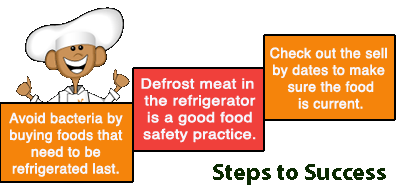
When defrosting, use the refrigerator and plan ahead. Leaving meat, poultry, or fish out on the counter is a big feast for bacteria. Although the meat is cold on the inside, the outside of your hamburger meat or chicken breast are now rising in temperature. Heat won’t necessarily kill all of those bacteria. Also, some bacteria such as Staphylococcus aureus and Clostridium produce toxins and spores that are not heat sensitive. That’s right, cooking isn’t going to destroy them -meaning you are still at risk of having your family develop a stomach ache.
You can use water to defrost but ensure your package doesn’t have any leaks. Use cold water and change the water every 30 minutes. You still may be at risk for food borne illness as the surface of the meat is rising in temperature. Planning ahead and placing the frozen item in the fridge is still ideal. If your chicken isn’t defrosted, just have a veggie dinner tonight; let the chicken continue to defrost in the fridge on a plate until the next day.
Cooking:
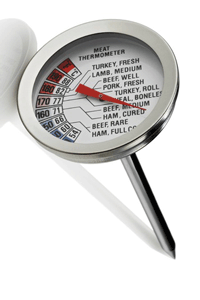
When cooking, use a meat thermometer. For example, chicken breasts should reach 170° F. Although people like their hamburgers pink inside, realize that ground beef is the food most associated with E. coli O157. Ensure your hamburger reaches 160° F. Use the thermometer when reheating food as well.
Storing:
When storing leftovers, use airtight shallow containers for rapid cooling to prevent the growth of bacteria. Hot food placed in a large containers can take up to 24 hours to be cooled to 40°F. This means bacteria is growing in your homemade chili plus the entire refrigerator has heated up too (meaning germs are having a party in the milk, turkey slices, etc).
In a hurry to get to the movies? Use an ice bath to help cool the temperature of your hot soup. Take a larger tray with ice and water to help cool down your container. Then place your chili or soup into the fridge.
Two hour rule:
After you’ve eaten a great meal, place leftovers in the refrigerator within two hours. Leaving cooked food at room temperature for too long is an invitation for bacteria like Salmonella to grow in your food. Re-heating will not destroy the toxins and spores produced by these nasty bacteria.
Also, you can’t see germs and sometimes it takes awhile before a bad smell develops. Rule of thumb, eat leftovers within two to three days. After that, it is garbage time.
Separating:
When prepping a meal, use separate cutting boards for produce (lettuce, tomatoes, etc) and meat, poultry, and fish which can be contaminated with bacteria such as e.coli and salmonella. Salad and vegetables may not be cooked and thus you expose yourself and your family to a salad that has been contaminated with germs from the meat.
Cleaning:
This seems like an obvious one but most people don’t wash for the entire 20 seconds that is needed to kill germs. Also make sure to wash your wrists. Often times during meal prep, we may accidentally wipe our hair back or pick up the phone. You may need to wash hands several times during meal prep. Get your kids to help with meal prep too and ensure they have soap easily accessible to wash their hands too. Teach them to sing a song, count, or use a timer.
Don’t forget that veggies and fruit need to be cleaned. They have been handled a lot and traveled in boxes to get to your local store. You don’t need special cleanser, just wash thoroughly.
Be especially careful of cantaloupe and use a scrub brush because of its textured surface. Dirt and bacteria can be sitting on the surface; once you slice a knife through the melon, the bacteria will just go along for the ride. Washing will not kill E.coli or salmonella though (only high heat can kill bacteria).
For more information, check out www.fightbac.org or www.cspinet.org (Center for Science in the Public Interest).
For a Germ Free Thanksgiving:
Quick Tips to Prevent Food Poisoning on our Thanksgiving Turkey Holiday:Plan ahead: If you have purchased a frozen turkey, place the turkey in its original package into a baking pan and place in the fridge. Allow 24 hours of thawing time for every five pounds of turkey (example: if your turkey weighs 10 lbs, plan on two days to defrost). If you won’t have room in the frig, order a fresh turkey the day before.
Use a thermometer: Stuffing should be cooked outside of the bird to allow it to reach the proper temperature. If you do place it in the turkey make sure it reaches 165° F. The turkey needs to reach 180° F (inner thigh), 170° F (breast).
Large Party? If you are making large batches of food ahead of time, use shallow dishes to cool them down quickly and keep the fridge at the right temp – 40°F (see food safety article on the Danger Zone and storage information).
Serving buffet style: Place food in small portions on the platter (or place food platter with larger portions on an ice bed). As food runs out, bring out more yummy food on a fresh plate (remember the two hour rule too).
Brining the turkey: This is a great way to have a moist turkey; make sure you place the turkey in the solution in the fridge the day before (in other words, don’t have it sit out on the counter otherwise you will be serving up brined germs).
Ready for leftovers on Friday? Placed turkey slices, mashed potatoes, and other side dishes in shallow airtight containers within an hour after cooking (no longer than 2 hours). Eat leftovers within the next three days. After that, it is time to toss it out and get ready the next holiday.
Have a question on the Day of Thanks: call the USDA’s Meat and Poultry hotline: (888) 674-6854 (special hours on Thanksgiving: 8:00 a.m. to 2:00 p.m., Eastern Time).
Written on November 2008
Last updated: July 2009
Quick Links
Family Nutrition News
Read our recent articles
Daily Tips Calendar
Print and post fun daily tips.
Interactive Nutrition Tools
Free meal planner, BMI, and more!
Family Nutrition Blog
The latest news facts and tips.
Printable Healthy Living Tips
Fun and easy tips - for the whole family.
Kids Fun Links
Explorers - Kids’ Page
Kids monthly healthy tips
Back to Main Nutrition Articles Page