Increasing Your Child’s Fruits And Vegetables – It’s Not As Hard As You May Think
Tips and tools to help you get your family eating more fruits and vegetables.
We all know that kids need to eat plenty of fruits and vegetables. We heard this as kids and we certainly hear this as parents. Most of the vitamins and minerals children need to develop, grow, think and fight disease are found in fruits and vegetables. But getting kids to eat enough fruits and vegetables seems to be a very challenging task. Most kids, in fact, more than 85% of elementary school children, do not get the recommended amount of fruits and vegetables.
Of course, you want your kids to eat healthier foods but the challenge is how do you do this without nagging and creating a negative experience at the dinner table. That is the real challenge! We understand that with all the tasks you manage daily, who has time to come up with practical solutions.
We have put together specific ideas and tips on how to increase your child’s fruit and vegetable daily consumption in a positive way..
Fruit and Vegetable Recommended Servings for Kids
You may be asking, just how much fruits and vegetables does my child need? In general, kids need 1 to 2 cups of fruit each day and 1 ½ - 3 cups of vegetables each day. This amount varies depending on their age and activity level. Having a goal of five servings of fruits and vegetables a day is a good nutritious goal. (for most fruits and vegetables, a serving is a ½ cup, medium-size piece, or 6 oz of 100% juice)
To find out exactly how much fruits and vegetables your child needs for a balanced diet, use our meal planner tool that is based on the USDA food pyramid.
Planning Steps to Promoting More Fruits and Vegetables
Increasing your child’s fruits and veggies starts with a little bit of planning. It is important to include them so they will feel more invested in improving the family’s overall diet. It is important that this be a family experience rather than “just for the kids.”
Keeping them involved and exposing them in different ways to fruits and vegetables is a key element to getting them curious and interested in these healthy food groups.
With just a few steps you can set your child and family up for a positive experience as you begin to improve their eating habits.
Healthy Tips to Creating a Positive and Healthy Eating Experience
Set realistic expectations. You don’t want to get frustrated and upset if your child does not want to eat healthier foods. This will only make mealtimes miserable for you and them and that won’t help them improve their eating habits. Trying to force them won’t really help either. Remember, you don’t want to win “the battle” you want to win the war!” Patience and persistence are the keys to your success.
Here are some general guidelines to help you promote a positive and encouraging atmosphere to kids.
- ✰ Keep them involved and try to find different ways for them to have repeated exposure to fruits and vegetables.
- ✰ Some studies say that it could take 15 times of seeing a particular fruit or vegetable before the child will try it.
- ✰ Be a great role model and show your children how much you enjoy fruits and vegetables
- ✰ Forget the nagging, it only makes eating fruits and vegetables a “punishment” for kids. We want kids to associate fun and positive memories with eating these healthy foods
- ✰ Avoid using any foods as a reward
- ✰ Move the fatty and sugary foods out of sight to avoid competition with your healthy choices.
- ✰ Talk with other parents and share ideas and recipes
Increasing Fruits Consumption Throughout the Day
Fruit juice makes up about 40% of the average child’s fruit intake. Giving fruit juice may seem like an easy way to get your child to get their fruit intake; but, fruit juice is very high in sugar and calories. The ADA recommends that children drink only one 6-ounce glass of 100% fruit juice a day as part of their fruit intake.
Here are some ways to increase your child’s fruit intake throughout the day:
- ✰ Start their morning with fresh fruits every day
- ✰ Add fresh fruits to cereals at breakfast time
- ✰ If your child likes fruit juice, then limit them to one glass a day of 100% fresh fruit juice
- ✰ For children who drink a lot of fruit juice, you can start by cutting the juice with some water and slowly decrease their amount to once a day
- ✰ Mix up their choices, fruits come fresh, frozen and canned. Read the labels and avoid canned fruits that have “added sugar”. Fruit comes naturally sweetened and does not need more sugar
- ✰ Avoid canned fruit that is packed in “heavy syrup”. Instead look for canned fruits that are packed in their own fruit juice
- ✰ Include some type of fruit at each meal, even a few grapes in a baggie for lunchtime or snack time
- ✰ Keep some fresh fruit cut up in the refrigerator at eye level and ready for a quick snack
- ✰ Use fresh or frozen whole fruits to jazz up their smoothie
- ✰ Look for fruit in season for better prices
- ✰ A handful of dried fruit makes a great snack and is packed with nutrition
- ✰ Fruit is a tasty dessert. But if the kids baulk at this, try adding some fruit to their favorite desserts
Increasing Vegetable Consumption Throughout the Day
You may be surprised to learn that in the United States french fries is the most common vegetable eaten by kids. Unfortunately, french fries are not a very healthy choice as their main source of vegetables.
Here are some tips to help you move vegetables front and center in your child’s daily meal.
- ✰ Keep vegetables in bite size on the table in plain view
- ✰ Try adding some cut up vegetables with a dip for a dinnertime
- ✰ Have some crunchy vegetables in a baggie for on the go snacks
- ✰ Pair vegetables with foods that your child enjoys. Sometimes being a little creative with the vegetables peaks their interest
- ✰ Mix up some greens with their baked potato, noodles or rice
- ✰ Have the kids help make a salad and then give it a special name and let them proudly serve it
- ✰ Add vegetables to pasta sauces
- ✰ Add vegetables to soups, beans and casserole dishes
- ✰ Try to always have at least one or two vegetables at dinner time
- ✰ Green leafy vegetables are very rich in nutrients, try different green leafy vegetables in salads, sautéed or steamed
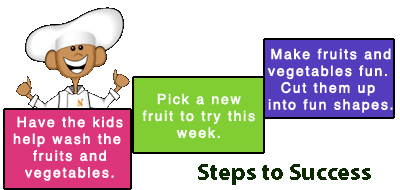
- ✰ Encourage your child to be color their plate with their vegetables, they come in so many colors and can be cut in different fun shapes
Other Tips to Help Peak Kids’ Interest in Fruits and Vegetables
Shopping List – organized by food groups
Fruits and Vegetables in Season
More Fruits and Veggies Kids’ Agreement
Keeping fruits and vegetables interesting and fun will help kids become more curious about their taste. Find ways to have them interact with these healthy foods in fun ways!
- ✰ Share some fun food facts. The more kids learn about fruits and vegetables, the more interested they may become in it
- ✰ Plant your own fruits and vegetables on your deck, large pottery or in your yard
- ✰ Having your child plant the seeds and take care of the plant while it grows is a very fun way to help them learn about fruits and vegetables
- ✰ Have them pull or pick the vegetable or fruit! You may be surprised at how interested they will become
- ✰ Take a trip to the local farm. This is a great outing for the kids and a fun way for them to see first hand food growing on a farm
- ✰ Find picking farms that let you pick your fruit or vegetable during harvest time
- ✰ Have the kids find recipes that use fruits and vegetables
- ✰ Try cutting fruits and vegetables into different shapes and let them make a picture before eating them
- ✰ Have them play some online nutrition games that are fun and teach them about healthy choices.
- ✰ Celebrate success even if they are small steps
Finding ways to increase your child’s fruits and vegetables doesn’t have to be a great undertaking. Start with just a few changes and allow your family to gradually become used to it. Then add more healthy changes over time so that it doesn’t feel like an abrupt change in lifestyle. Habits take time to develop.
Helping kids develop healthy habits and eat healthier foods is the foundation to their overall health. It is definitely worth the effort. And remember, each change does make a difference!
Written on: March 2010
Last updated: April 2010
Quick Links
Family Nutrition News
Read our recent articles
Daily Tips Calendar
Print and post fun daily tips.
Interactive Nutrition Tools
Free meal planner, BMI, and more!
Family Nutrition Blog
The latest news facts and tips.
Printable Healthy Living Tips
Fun and easy tips - for the whole family.
Kids Fun Links
Explorers - Kids’ Page
Kids monthly healthy tips
Back to Main Nutrition Articles Page